Instinct for customer acquisition: what real users got done
A user's trigger-based email pipeline, independent hands-on results and a costly missed condition. What those accounts mean for LinkedIn customer acquisition.
The strongest sales-related Instinct account is not a claim that it can run LinkedIn for you. It is a user describing a pipeline built around public triggers and drafted emails, with a concrete obstacle along the way: missing contact information.
That is a useful starting point for a founder. Research, finding an address, drafting a message and sending a LinkedIn DM are different jobs. Real accounts show work getting done, but also why the channel, the requested outcome and the limits matter.
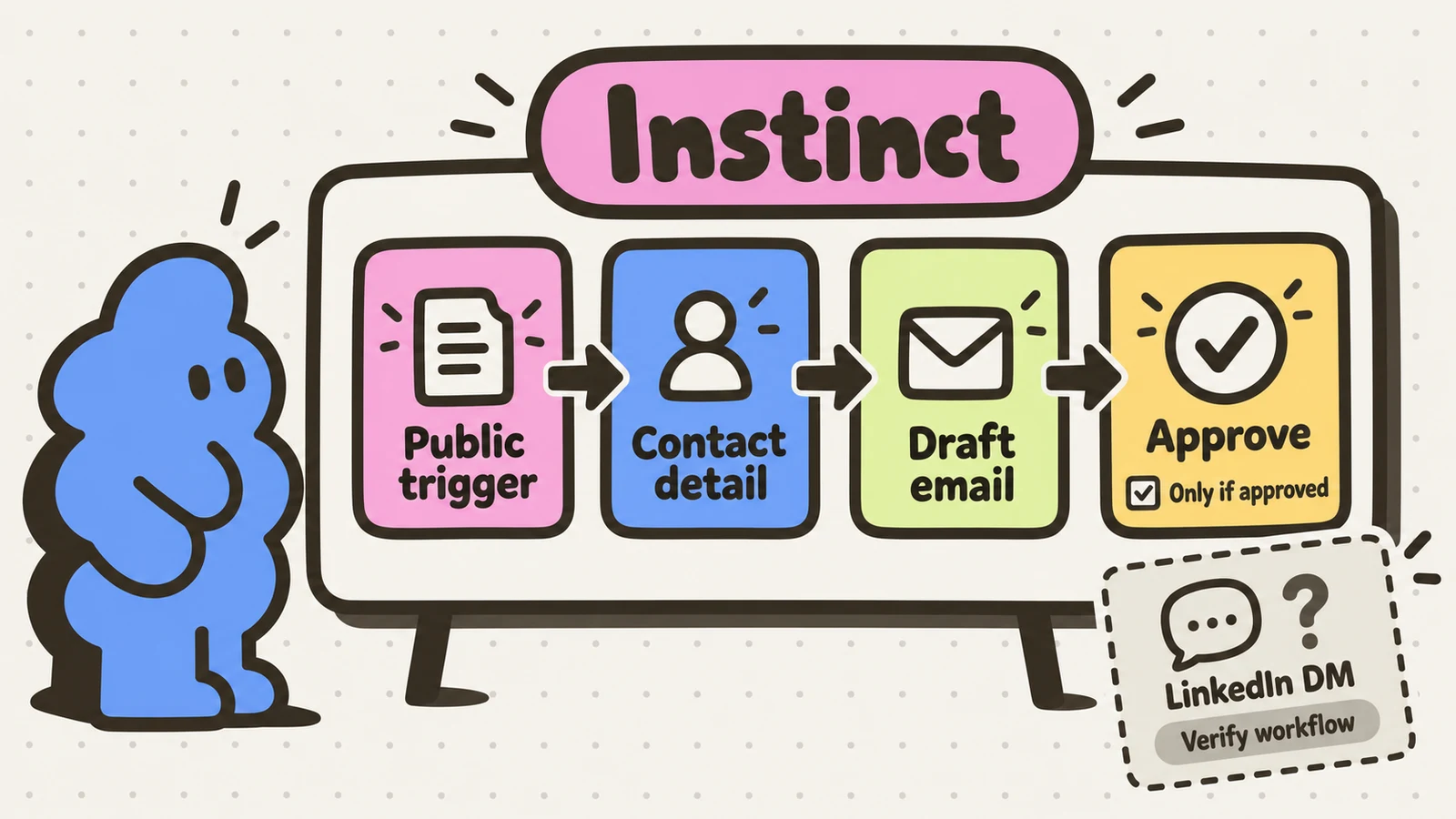
A pipeline account with a specific missing piece
A September 8 LinkedIn post from the nathanielmc account describes using Instinct for several weeks and handing it standing tasks. The most relevant claim for customer acquisition is:
Built a pipeline for Dealyo by watching public triggers and drafting emails for me.The post says Instinct knew names of people the user wanted to reach but lacked their email addresses. According to the account, it signed up for Apollo with the user’s approval, then asked for approval to open a paid account after reaching the free limit. The user agreed.
That is a concrete account of moving past a data gap, not just generating a polished message. It also describes email preparation, not a LinkedIn campaign. The post supplies no lead count, reply rate, customer count or campaign log. It includes an invite promotion and says the author is not an investor. Treat the outcome as that user’s report, not proof of increased sales or an independently audited workflow.
For your own acquisition task, decide what the assistant should produce: a sourced company brief, a list with verified contact details, or a draft tied to an actual trigger. Decide separately whether it may buy data. A missing address should not silently turn a research job into a subscription purchase.
Business follow-up still needs an owner
In a September 23 AI with Kyle account, the writer describes using Instinct through WhatsApp to sort stalled projects and follow-ups into work for himself, his team or AI. He chose which projects to keep, pause or kill, and kept direct revenue work on his own desk. Instinct then brought him daily commitments and a few older decisions at a time.
The same account describes collecting bookkeeping invoices and checking a conference invitation against travel and schedule before drafting a decline. The writer says he is not sponsored or affiliated with Instinct. He connected email and calendar but withheld password-manager and payment access. These are specific business-admin uses, not evidence that acquisition or sales decisions can be left entirely to an assistant.
Independent tests show follow-through and a missed condition
The pipeline account sits alongside hands-on reporting about other kinds of work. Those tests help explain the appeal of a persistent assistant without pretending a restaurant booking proves a LinkedIn feature.
| Account | Reported result | Limit that matters |
|---|---|---|
| Zoë Schiffer, WIRED, September 24 | Instinct booked restaurant reservations for her Venice itinerary, including contacting places through WhatsApp. | Completed personal coordination is not evidence of a prospecting campaign. |
| Schiffer’s flight change | Found that a flight had moved 90 minutes earlier, obtained a refund she valued at roughly $550, and rebooked her return. | The result depended on that itinerary and refund eligibility, not a general savings promise. |
| Schiffer’s delayed food order | Canceled the order, costing her $64, despite her instruction to cancel only if she could get a refund. | A stated condition was not preserved in that reported task. |
| Allison Johnson, The Verge, October 2 | Instinct found and arranged a free coworking trial that Dots had missed when it proposed a paid pass. | A specific comparison on one task, not a universal agent ranking. |
| A September 9 post from the aoslerne account | Described holiday shopping and vendor coordination as a load off. | Also reported marketing-email signups, costly delivery choices and sometimes missed vendor replies. |
| Bizhankook, September 29: business-trip booking | Compared flights, hotels and cancellation terms; halted when the selected hotel’s price rose. | The account does not report a completed booking; stopping at a changed price preserved the decision for the user. |
| The same reporter: send a daily work report by text | The reporter ended up sending it manually after supplying a phone number. | Instinct said it could not send through the user’s own texting account to a non-Instinct recipient in that test. |
The missed refund condition is especially relevant to commercial work. A draft is not permission to send. An available contact is not necessarily the right person. “Only if” has to survive the action, not just appear in the conversation before it.
The failed work-report task is a useful channel limit. An assistant receiving your messages is not the same as it sending through your account to anyone you choose. That September test does not establish current support for every messaging channel.
The accounts also differ in what the users valued. Finding the free option completed Johnson’s requested job. An expensive delivery choice frustrated the holiday-shopping user even though it moved the errand forward. Define success in terms of your request, not activity alone.
What this means for LinkedIn outreach
The trigger-based pipeline account gives you a reason to consider Instinct for acquisition preparation. It does not establish LinkedIn invitation sending, DM delivery, reply detection or a campaign queue. The independent tests above do not fill those gaps either. LinkedIn sending remains a separate capability to verify, not an assumed extension of email drafting.
Start with a reviewable piece of work. Give the assistant the audience, a permitted source set and the output you want. Require evidence for a claimed company change. Keep unknown details marked unknown. Don’t let a missing source turn into invented personalization.
Before any contact, check the final recipient, words and channel. If an assistant proposes operating your LinkedIn account, find out what route it uses and what remains under your control. LinkedIn’s prohibited-software guidance prohibits third-party scraping and unauthorized automated activity, including messaging, and warns of account restrictions. Successful browser work elsewhere is not permission to automate LinkedIn.
For message preparation, our factual-edit test shows a separate check worth applying: did the edit invent a relationship or hide a paid offer? A factual source list does not guarantee an accurate finished DM.
Choose the job you need help with
The real case for Instinct here is follow-through across research and administrative work, with a user-reported acquisition example in email preparation. The failure accounts are a reason to make conditions and approvals explicit, not to call every task unreliable or every success risk-free.
If your immediate job is a LinkedIn outreach queue, Dollar Outreach arranges steps and prefills drafts in the LinkedIn sidebar; you review and click send yourself. It does not find your leads or write the offer with AI. Third-party-tool policy risk still applies. That narrower job should not be confused with asking a general assistant to own the whole acquisition process.
Updated October 3, 2026. The linked user accounts and independent hands-on reports support the outcomes above; their reported results are not sales benchmarks.