They replied "send me more info": answer the request before asking for a meeting
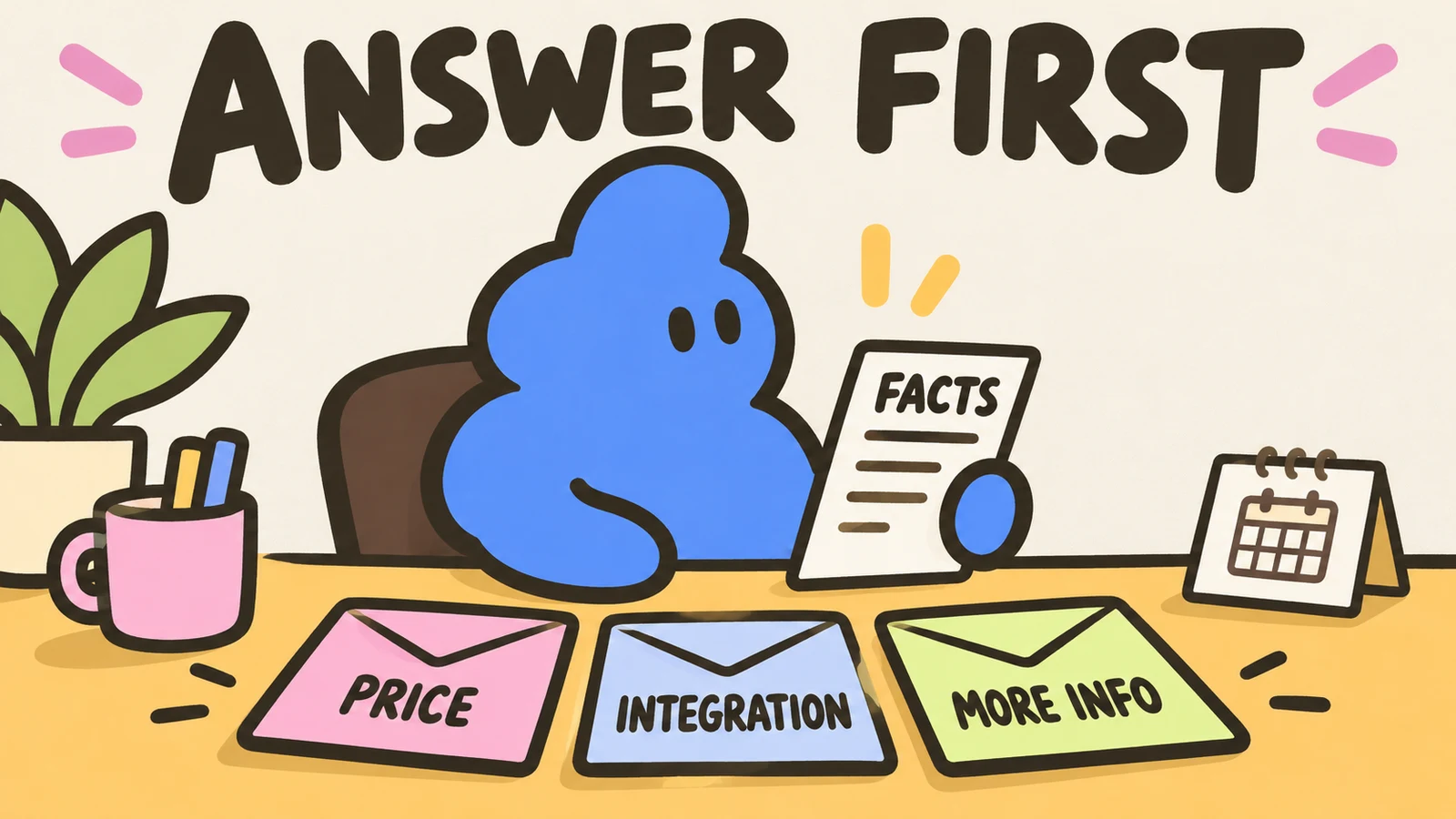
Three fictional replies checked against one product fact sheet: price, an integration question, and a vague request for details. Give the recipient something they can evaluate without making a call the price of admission.
You offered to send information. They said yes. Your next message should contain the information, not a calendar link in its place.
That does not mean they are ready to buy. It means you have a request to answer. Start there before deciding what the reply says about their interest.
Sellers and buyers read the same reply differently
A June 28, 2026 cold-email account describes replies such as “Yes, send the Loom” and “send me more information,” followed by silence after the sender sends material. The sender asks how to turn those replies into meetings. The thread offers opinions, not a measured conversion baseline, and it concerns email rather than a LinkedIn experiment.
In an October 2, 2025 sales discussion, some sellers call the request a brush-off. A commenter speaking as a buyer says they ask for particular information and do not care much about its format as long as it is there. Another suggests asking what information the recipient wants.
The disagreement matters. “Always a buying signal” and “always rejection” both claim more than these accounts establish. A price question, a technical question and a vague request deserve different answers.
A 2020 discussion makes the narrower point: ask which information matters and respect the requested communication preference. In a 2024 LinkedIn discussion, a commenter reports asking permission to send information and sometimes receiving an email address. That is a self-report, not a validated success rate or permission to contact someone through any channel you can find.
There is an opposing position too. A March 29, 2026 vendor post argues for offering an audit instead of a deck and claims it wins “every single time.” It supplies no measured comparison supporting that claim. An audit can be a relevant offer; it should not replace the information a recipient just requested.
The fact sheet for our exercise
The product, recipients and replies below are fictional. We wrote the answers ourselves and checked them manually. No messages were sent and no replies or sales outcomes were measured.
Product: ReportKit, a fictional weekly-report tool.
Job: turn uploaded CSV files into a weekly summary.
Price: $49/month for one workspace, up to five users.
Setup fee: none.
Supported input: CSV upload.
Native integration: HubSpot is not supported.
Salesforce integration: not verified in this fact sheet.
Trial: 14 days; no card required.
Source material available: pricing page, CSV setup guide,
and supported-integrations list.
No evidence supplied: hours saved, revenue lift, customer logos,
recipient pain, urgency, or approved purchasing budget.
The bracketed sources in the drafts are placeholders for the fictional product’s material, not working URLs. Replace them with a real source you have checked before using an example.
Reply 1: they asked the price
Fictional recipient reply:
Send me the price and whether there's a setup fee. I'm not ready for a call.Our draft:
It's $49/month for one workspace with up to five users, and there's no setup fee. Here's the pricing page: [pricing page]. No call needed to review it.We checked the amount, billing period, workspace and user limit, and setup fee against the fact sheet. The answer does not infer a budget or ask the recipient to explain their business before seeing the price.
A meeting could become useful later. It is not needed to answer these two known facts.
Reply 2: they asked about an integration
Fictional recipient reply:
Can this pull directly from HubSpot? We also use Salesforce.Our draft:
It doesn't have a native HubSpot integration; it uses CSV uploads. I haven't verified Salesforce support. Here's the supported-integrations list: [integrations list].The first sentence answers the direct question with a limit, rather than implying that a workaround is a native integration. The second keeps Salesforce unknown. It does not turn “not verified” into either “yes” or “no.”
The integrations list is relevant evidence. A general pitch deck would make the recipient search for the answer you already know.
Reply 3: they asked for “more info”
Fictional recipient reply:
Sure, send me more info.Our draft:
ReportKit turns uploaded CSVs into a weekly summary. It's $49/month for one workspace with up to five users, with no setup fee and a 14-day trial that doesn't require a card. Here's the CSV setup guide: [CSV setup guide]. Is your main question about the report output or getting your data into it?This gives a useful overview before asking one clarification. It does not require the recipient to answer a discovery questionnaire to receive the promised information.
We chose the setup guide because it explains the product’s actual workflow. If the earlier conversation had promised a particular example or video, that would belong here instead. “More info” is not a reason to send every asset you own.
Our manual check
Each draft received one point for each check below. These are checks against supplied facts and the recipient’s request, not a prediction of effectiveness.
| Check | Price reply | Integration reply | Vague reply |
|---|---|---|---|
| Answers the request before a new ask | Pass | Pass | Pass |
| Uses supplied facts; preserves unknowns where relevant | Pass | Pass | Pass |
| Offers only relevant source material | Pass | Pass | Pass |
| Does not invent pain, urgency or results | Pass | Pass | Pass |
| Does not require a meeting to receive information | Pass | Pass | Pass |
| Score | 5/5 | 5/5 | 5/5 |
All three pass this limited exercise. That does not mean a recipient will reply. It means the drafts did not dodge the question or add unsupported selling claims.
Keep the next step proportional
Send the requested material in the existing conversation or through the channel the recipient actually requested. An email address supplied for this purpose is not an invitation to call, text or add a calendar event.
If the recipient later asks for a walkthrough, offer one. If they decline or go quiet, do not reinterpret the original request as an agreement to meet. Our no-response follow-up guide covers that separate decision.
Dollar Outreach queues steps and prefills drafts in your LinkedIn sidebar; you review and click send. When someone replies, review the conversation before using another queued message. The recipient’s question should determine what you send next, not the fact that a generic follow-up is waiting.
Checked October 9, 2026: the five public discussions above, Dollar Outreach’s product page and the related follow-up article. The source accounts are self-reported and not controlled studies. The three drafts and scores are our manual exercise using fictional inputs.