How to ask for customer interviews without disguising a sales pitch
A founder's guide to asking for product-discovery conversations: say what you're building, make the first ask small, and don't turn an interview into a hidden demo.
A founder asks a stranger for 20 minutes to discuss a problem. The stranger sees a product category, a calendar link and a question about whether that problem costs them money. Even if the founder means “research,” the recipient can reasonably hear “sales call.”
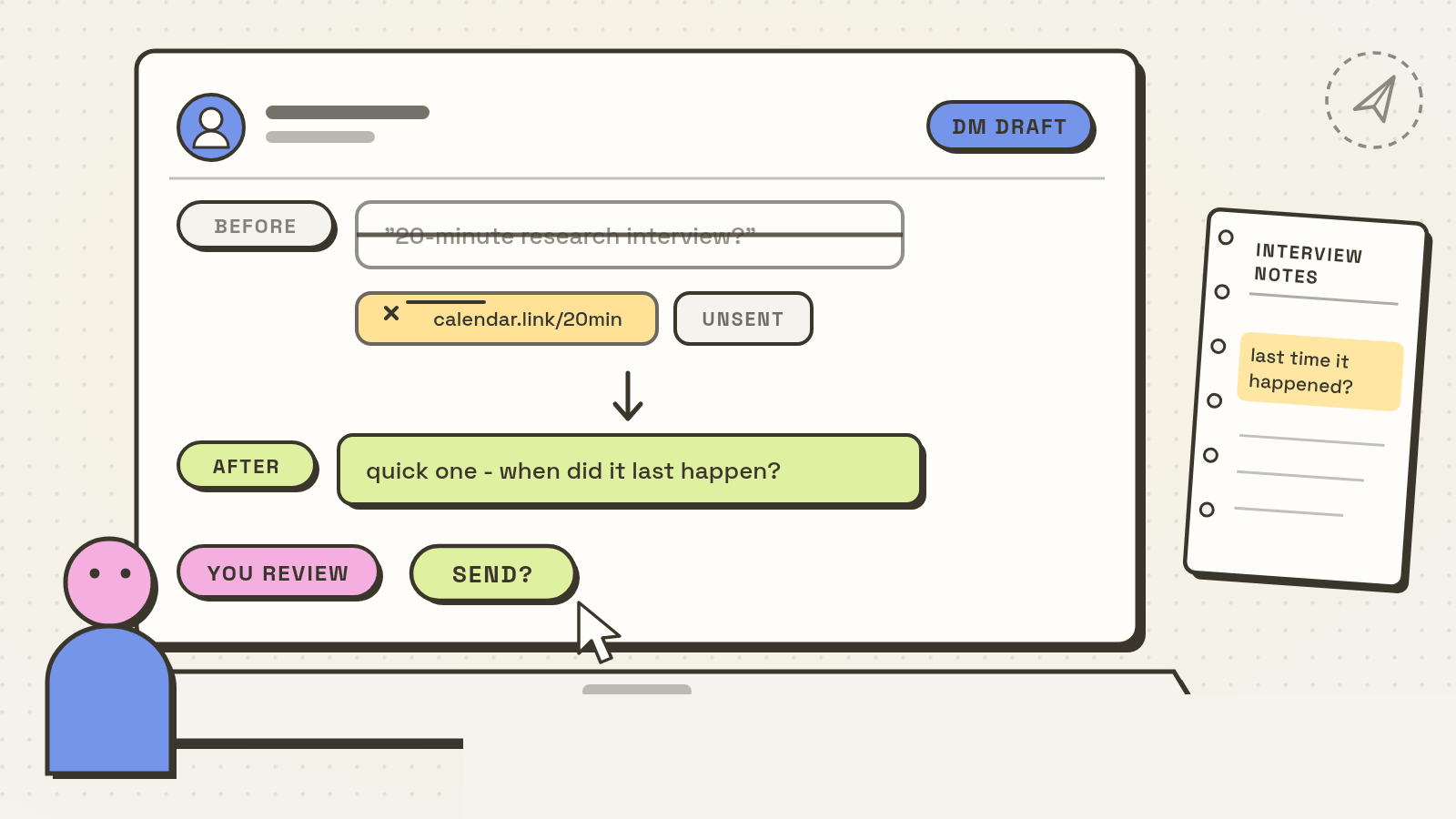
One r/startups founder shared the exact message they had been sending to CTOs and engineering heads in May 2026. They were building in agent reliability, sending about 30 LinkedIn DMs a week, and said most were ignored. Their opener began “not pitching anything, doing some research,” then explained what they were building, asked whether production regressions were costly, requested 20 minutes, and included a calendar link. Their follow-up offered a two-minute answer by DM instead, but asked three technical questions at once. These are the founder’s account, not a tested diagnosis of why each recipient stayed silent.
Name the purpose without making the recipient guess
“I’m not pitching” does not settle the question if you are building something in the space and might eventually sell it. Say that plainly. The interview should have its own purpose: learn about a recent event and how the person handled it, not collect objections to a product you have already decided to sell. If you plan to show a prototype, say so before they agree. Don’t slip into a demo halfway through a call labeled as research.
The original CTO message did name the field and target people. Its heavy lift was asking a stranger to assess a broad category, decide whether it mattered, and book time in the same first DM. A commenter who identified as a CTO suggested starting with a specific production failure rather than a general “reliability story,” with no calendar link in the first message. That is feedback from one person in the thread, not proof that shorter asks get more calls.
Match the ask to the relationship
Cold, with one public reason to write. Do not claim to know their systems from a job title. This is an illustrative message for someone who publicly discussed an incident; the bracketed detail has to be real.
Hi [Name] - I read your post about [specific public incident]. I'm building a tool in [area] and trying to understand how teams notice this kind of issue in practice. If you can share it, what first told your team something was wrong? No call needed.This asks one question, not three, and leaves room for “can’t discuss it.” If the incident involves confidential operations, do not ask for private details by DM. A public post is context, not consent to be interviewed.
After a real exchange. If they answered a question in a public thread or at an event, refer to the actual point they made. Don’t imply that a like or connection acceptance was a conversation.
Your point at [event/thread] about [specific detail] stayed with me. I'm exploring [problem area], and I'd like to understand what happened the last time your team dealt with [issue]. Would you be open to a 15-minute research conversation next week? I won't turn it into a demo.The 15 minutes are an illustrative ask, not an optimal duration. If you already promised them an answer or resource, deliver that first. If you do have a product to show, replace the “no demo” promise with the honest agenda.
After they show interest in the problem. Now a calendar link may save a step. Confirm the topic, the time requested and whether you want product feedback as well as a story of how they work.
Thanks for describing [problem] in your reply. Could we spend 20 minutes on the last time it happened and what you tried? I'm building [product category], but this call is for understanding the workflow, not a sales demo. If you'd also be willing to look at a prototype, I can make that a separate conversation. [calendar link]Use a link only after they have agreed to a call or asked for scheduling, not as a substitute for a reason to speak. Honor a no, a non-response or a request to stop.
What the conversation is for
Ask about an actual past instance: what triggered it, what they did first, what they tried, and what remained hard. Y Combinator’s user-interview lecture asks about the last time a problem occurred, why it was hard, and what the person has already tried. Those questions get closer to current behavior than “Would you buy my solution?”
A different founder reported that contextual outreach for idea validation and design-partner calls worked better for them: they described engaging with relevant Reddit threads before a DM and reading LinkedIn backgrounds before a tailored message. They reported two LinkedIn calls, three Reddit calls and two meetup calls in one week. That is a separate, self-reported experience, not a reply-rate comparison with the CTO founder’s campaign or a promise that the same approach will work for your audience. The useful question to borrow is whether this person has already shown the problem matters to them.
If someone replies by DM with a useful answer but declines a call, thank them and leave it there. Don’t turn their courtesy into a sequence of meeting requests. If the person was introduced by a mutual contact, explain what that person said you could ask, without overstating the introduction.
Dollar Outreach can keep a founder’s chosen follow-up steps in a sidebar on the LinkedIn tab and prefill a draft. The founder reviews the thread and clicks send. That’s useful for remembering a promised resource or an agreed interview; it cannot make a cold research request welcome. The first-ten-customer playbook covers the broader loop from finding a relevant person to learning from the first conversations, and the accepted-connection guide covers the narrower case when there has been no first DM.
Checked September 29, 2026: the two r/startups posts and their visible comments, and the YC interview lecture linked above. The sample messages are illustrative, not reply-rate claims. The founders’ reported outcomes are anecdotes.