They accepted your LinkedIn connection but did not reply. What next?
A founder's decision guide for a newly accepted LinkedIn connection: when to send a first DM, what to say, and when to leave it alone.
Someone accepted your LinkedIn invitation. Your inbox is still quiet. Before you call that a non-response, check whether you actually sent a message. An accepted connection and an unanswered DM are two different situations.
LinkedIn says acceptance makes you first-degree connections. Its messaging guide says you can message a first-degree connection directly. If you are not connected yet, the free routes to reach someone are here: how to message someone on LinkedIn without Premium. Neither step means the person agreed to hear a sales pitch or promised a conversation.
First, read the thread
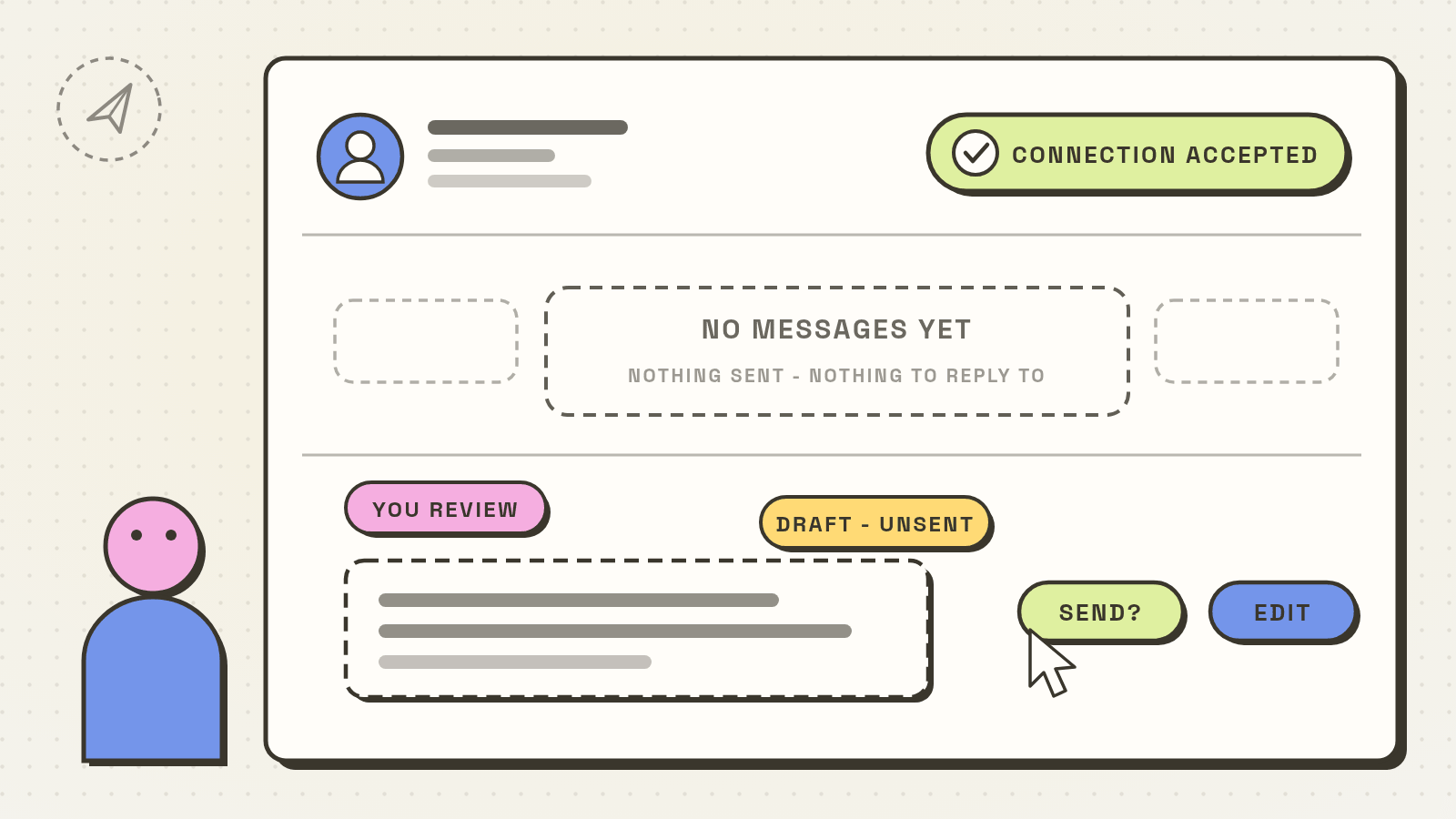
No first DM from you: You can send one if you have a clear, current reason to speak to this person. Check the invitation note you sent, their role, and the source behind your reason. A note that already asked a question may have said enough; don’t simply paste the same ask into a DM.
You sent a first DM and they did not answer: That is a follow-up decision, not an opening-message problem. Read the existing thread before writing anything else. Our follow-up guide covers when a new detail earns another message and when to stop. Do not send the examples below as though the first DM never happened.
They replied elsewhere or said no: Respect that answer. A LinkedIn silence does not erase an email reply, a meeting, or a request to stop.
If you haven’t messaged them, find the reason first
“Thanks for connecting” is courteous but does not tell them why this conversation should start. Look for a specific shared context: a discussion you both joined, a public question they asked, or a company change relevant to what you do. Verify the detail before mentioning it. LinkedIn’s own connection guidance recommends a clear professional reason to reach out, such as having met or wanting to continue a conversation.
Don’t translate an announcement into a private problem. A company hiring sales staff does not prove its current process is broken. If you cannot name the source and explain why the person, rather than anyone at the company, is worth asking, leave the connection alone for now. The prospecting prompts offer a way to separate checked facts from guesses before you write.
Three first DMs, each for a different situation
These are fictional patterns, not notes to send unchanged. Replace the brackets with something you checked; if you cannot, skip the message.
You met briefly at an event. Reopen the exact conversation, not the fact that you are now connected.
Good to connect, [Name]. At [event], you asked how we handle [specific issue]. I checked [short answer or resource] after we spoke. Would it be useful if I sent it over?Only use this if you actually spoke and have the answer. If you already promised to send a resource, send the promised resource instead of asking for permission again.
They asked a public question you can answer. Help with that question first; don’t smuggle in a demo request.
Your post asking about [specific question] caught my eye. We tried [relevant approach], and [one concrete limitation] mattered more than expected. Would the short write-up help?The post, experience and write-up must be real. If the recipient already got a good answer in the public thread, adding a private pitch is unlikely to help.
There is a relevant change at their company. Ask about the work without declaring a pain point you cannot see.
I saw [company] announced [verified change]. I work on [specific related problem] with [type of team]. Does [question about how the change affects their work] sit with you, or someone else?Check that the announcement is current and that their role plausibly touches the question. A job title alone is not enough. If the question is a thin disguise for “book a call,” rewrite it or don’t send it.
When leaving it alone is the better move
You do not need to send a DM just because a new connection appeared in a list. Leave it alone if you have no relevant reason, if your invite already made your ask and got no answer, or if they declined contact somewhere else. You can remain connected without running a sequence. LinkedIn lets recipients report conversations as spam; the fact that a message is technically available does not make every message welcome.
If you do send, log the first-message date and what you asked. That prevents a later “first” message from landing on top of an unanswered one. Dollar Outreach can hold your chosen sequence in a sidebar on your LinkedIn tab, but you review the actual thread and click every send. An empty reason-to-write field is a good reason not to queue the next step. For more situation-specific cold openers, see the founder templates.
Checked September 28, 2026: LinkedIn’s invitation, messaging, connection and spam help pages linked above. The sample messages are fictional and not tested for reply rates; adapt them to verified facts and the existing thread.