Before rewriting your LinkedIn pitch, check whether this person has a reason to buy
A buyer-situation worksheet for founders: separate a relevant job title from a current problem, match your offer to the evidence, and decide which messages not to write.
A founder can fit your customer profile and still have no use for your offer today. Rewriting the opener does not change that.
Before drafting another LinkedIn DM, write down the job you could help this person do, what makes it current, and what you can actually deliver. If the only evidence is their title, you have a possible audience, not a reason to pitch.
Three outreach accounts, not a reply-rate formula
In a February 9 Reddit account, a founder described repeatedly rewriting messages to SaaS founders and software builders without getting replies. They then narrowed the audience around problem, urgency, ability to pay and reachability. They reported one real reply from 20 people.
That is an unverified first-hand account, not proof that targeting caused an improvement. What makes it useful is the distinction: two people can have the same title and different reasons to care.
A March 3 account described five months and 1.5k combined cold emails and LinkedIn DMs, with four conversations and no calls booked. The sender filtered for small-company founders and recent activity, or people posting freelancer requirements. Their sample offer bundled developers, designers, editors, project management and replacement talent.
The comments disagreed about copy, follow-ups and delivery. The post does not establish which problem mattered most, and its mixed channels are not a LinkedIn benchmark. It does show why a long list of relevant services can still leave the recipient unsure which current job the sender will handle.
In a February 25 discussion, a sender recommended opening with an observation and no pitch. Recipients called that a disguised sales opener. Removing the offer does not make a commercial conversation noncommercial. Your worksheet should state what you sell, even if the eventual message is short.
Fill this out before writing
Use one sheet per person. Keep an observation separate from your interpretation of it.
Person and company:
Observable job or problem:
Source for why-now: URL, date, and what it actually says
Offer: paid deliverable, scope, and limits
Evidence missing: need, timing, budget, authority, or fit
Decision: WRITE or SKIP FOR NOW
Reason for that decision:
A source for why-now might be a recent request for a contractor, a dated description of a recurring task, or an announced deadline. A funding round or hiring post may suggest a change, but neither proves demand for your service. Keep the source so you can check whether the situation has changed before sending.
Budget unknown does not always mean skip. It means you cannot write as though the person has approved a spend. Need unknown is different: if you cannot connect your deliverable to a real job, there may be nothing useful to offer yet.
A manual audit of three fictional situations
These are invented teaching cases, not customer records, public posts or outreach results. The source descriptions below are fictional inputs. No messages were sent and no replies are predicted.
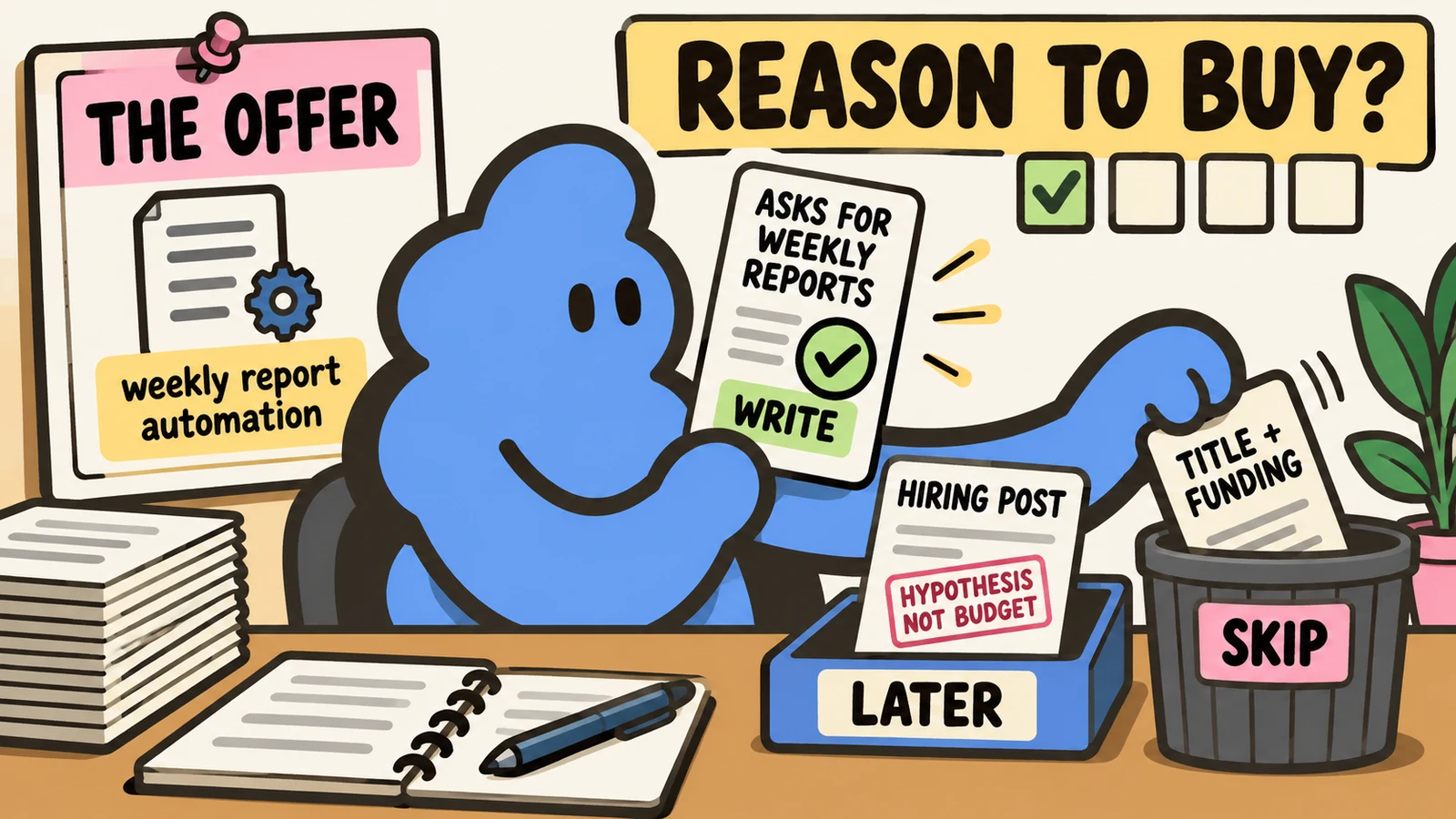
For all three cases, the sender sells a paid weekly-report automation sprint: turn one existing spreadsheet into a repeatable report, document the handoff, and work within the buyer’s existing approved tools. The sender does not offer recruiting or a new analytics platform.
1. A current reporting problem: write
Situation: Lina runs a small agency. A fictional post dated October 4 describes staff manually combining campaign spreadsheets every Friday. It asks for recommendations for someone who can automate that report without changing the agency’s tools.
| Worksheet field | Manual audit |
|---|---|
| Observable job/problem | Combine existing campaign sheets into a weekly report. |
| Source for why-now | Fictional October 4 post: recurring Friday work and a current request for help. |
| Offer | Paid automation sprint for that report, using approved existing tools. |
| Evidence missing | Sheet structure, access restrictions, exact scope, budget and purchasing authority. |
| Write/skip decision | WRITE. The described job fits the offer; use the message to establish whether the scope fits too. |
The defensible reason to write is the request, not a claim that Lina’s agency is inefficient. Do not promise hours saved or describe the sprint as approved. You still need to inspect the workflow before committing to a scope.
2. A hiring post: skip this offer
Situation: Theo’s company has a fictional October 5 job listing for a full-time data analyst. The listing includes reporting alongside forecasting and customer research. It says nothing about manual spreadsheets or temporary contractors.
| Worksheet field | Manual audit |
|---|---|
| Observable job/problem | Hire an employee with several ongoing responsibilities. |
| Source for why-now | Fictional October 5 vacancy; current hiring, not a request for report automation. |
| Offer | The same paid weekly-report automation sprint. |
| Evidence missing | Whether a report bottleneck exists, whether contractors are considered, and whether this work belongs to Theo. |
| Write/skip decision | SKIP FOR NOW. The offer solves a narrower, unconfirmed problem than the hiring need. |
The vacancy is a hypothesis to research. It is not evidence that Theo wants a substitute for the hire, has contractor budget, or needs your service. A better opener cannot fill those gaps.
3. The right title, no current job: skip
Situation: Amira is a founder at a recently funded software company. Her fictional profile fits the sender’s usual company-size filter. The only recent announcement is about funding; there is no reporting complaint, deadline or request for operational help.
| Worksheet field | Manual audit |
|---|---|
| Observable job/problem | None established for this offer. Founder title and company size are profile facts. |
| Source for why-now | Fictional funding announcement; no evidence about reporting work. |
| Offer | The same paid weekly-report automation sprint. |
| Evidence missing | The problem itself, its owner, timing, tool fit and willingness to buy. |
| Write/skip decision | SKIP. There is no supported link between the announcement and this deliverable. |
Funding does not tell you which problem the company will spend on. Keep Amira out of this batch rather than inventing a spreadsheet problem to justify including her.
Carry the decision into your next batch
Only the first fictional situation earns a message for this offer. The other two may become relevant later, or fit a different service. Skipping them now is a targeting decision, not a verdict on the companies.
Use the worksheet to choose people before editing copy. Our no-replies guide covers other reasons a message may go unanswered. The prospecting-prompt article covers a separate research workflow; it cannot supply evidence that a buyer has a problem.
Checked October 6, 2026: the three Reddit accounts and their visible comments, plus the linked Dollar Outreach articles. The accounts are self-reported and not controlled studies. The worksheet decisions are our manual analysis of explicitly fictional inputs, not measured sales results.