Hark Pro for founders: what the first public tests actually showed
A slow food-ordering demo, visible approval steps and proactive reminders. What the launch reports establish before you hand Hark an admin task.
The clearest Hark Pro launch example is a Filet-O-Fish order that took several minutes and still needed a person to confirm payment.
That is not a failure by itself. An assistant can take longer than you while letting you work on something else. But it is a more useful starting point than calling Hark an operating system for your life: what did someone actually see, where did the person step in, and what remained unconfirmed?
Hark Pro launched on October 6, 2026, according to the launch-day reports below. We read the product announcement and independent coverage on October 7. This is an evidence review, not our own hands-on test or a comparison benchmark.
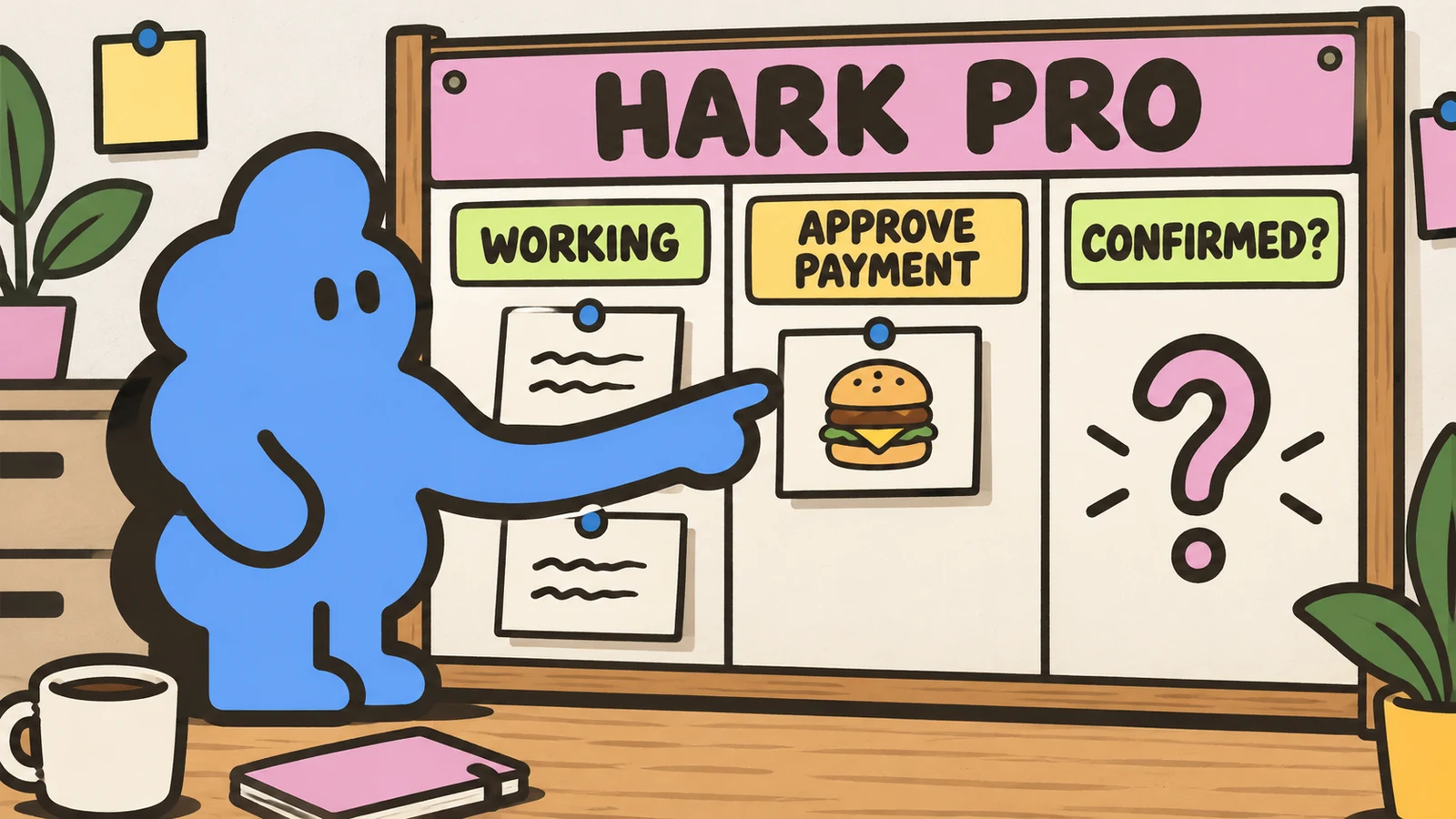
The ordering demo stopped at payment approval
Gizmodo’s Raymond Wong watched Hark design lead Abidur Chowdhury request a Filet-O-Fish delivered through DoorDash during a video call. Hark’s cloud computer clicked through the site and verified payment. After several minutes, Chowdhury still needed to confirm payment.
Wong pointed out that he could have ordered faster himself. Chowdhury’s answer was that he spent that time talking to the reporter while the agent worked.
This was a reporter-witnessed company demo. It was not Wong ordering through his own connected account, and the article does not establish delivery of the food. It supports a narrower claim: the demonstrated workflow progressed through ordering steps to a human payment-confirmation point.
For a founder, those are separate questions. How long did the task take? How much attention did it need? Did it reach the right final state? A task running in the background is useful only if you do not have to reconstruct it afterward.
What the other reports add
| Source | What the reporter observed | What it does not establish |
|---|---|---|
| Gizmodo, October 6 | Company-operated DoorDash demo reaching payment confirmation after several minutes. | A reporter’s independent completed order, delivery, or reliable performance on other merchants. |
| TechCrunch, October 6 | Company demo showing proactive prompts about expenses, emails, the reporter’s meeting and a flight to book. | Expense approval, email sending or a completed flight booking. |
| Fast Company, October 6 | Author says he tested the beta; the accessible text describes the chat and customizable homepage. | A verified admin-task completion in the portion we could retrieve. |
TechCrunch’s Tim Fernholz also described a small window showing the agent navigating the web. That makes progress easier to inspect. A visible browser is not, by itself, proof that the result is correct.
Our Intelligent UI calculator check asks a related question about interactive answers: can you inspect the inputs and math, and did a usable tool actually appear?
The same report includes Chowdhury’s story about Hark handling a colleague’s California DMV registration renewal. That is a company anecdote, not a renewal Fernholz watched. We are not treating it as another completed test.
Fast Company’s Nate Berg explicitly described trying the beta before launch. We could read the opening and interface discussion, but could not retrieve the continuation even after opening the original page and using its continuation control. We are leaving any later task examples out rather than filling the gap from summaries.
Features and prices are product claims, not test results
Hark’s announcement describes an iOS, Android and web app with a free tier. It lists $20/month for twice the usage and $100/month for ten times the usage. It does not give an absolute task allowance in the announcement, so those multipliers do not tell you how many errands your team can delegate. We did not check checkout terms, regional access or the apps in every store.
Hark calls its cloud computer Handoff. Its announcement describes scheduled tasks, Projects, proactive Action Buttons and customizable Panels. The announcement also claims broad website access and leading computer-use performance. The sources we read do not independently establish those claims across sites.
Gizmodo quotes a company example in which Hark buys movie tickets, finds parking and supplies the garage QR code. Wong explicitly says he cannot confirm that follow-through. Keep it in the proposed-capabilities column, not the observed-results column.
Hark says its encrypted vault protects passwords and cards, that the company cannot see those secrets, and that it will not sell data or share it with advertisers. Those are Hark’s security and privacy claims. The launch coverage is not a security audit, and we did not verify the implementation.
Give the first task a finish line
If you try Hark for founder admin, start with a task whose output you can inspect without trusting a story about what happened. Preparing options is easier to check than silently changing a reservation or paying a bill.
This is a suggested test brief, not a prompt we ran:
Find three options for [specific admin task].
Use these requirements: [location, date, constraints].
Do not book, buy, send a message or change an account.
Return the source links and the facts you checked.
Mark anything you could not verify.
Stop when the options are ready for my review.
Record what it returns, then open the sources. If you later authorize a paid action, review the exact item, total, destination and cancellation terms first. Count the approval and correction work as part of the task, not as invisible overhead.
For recurring work, check a full cycle before relying on a reminder card. A useful suggestion, an approved action and a confirmed result are different milestones. The launch reports demonstrate some of the first two, not a dependable recurring workflow for your business.
No LinkedIn-sending evidence here
None of these reports shows Hark sending LinkedIn outreach or acquiring customers. Ordering food and spotting an expense do not establish either capability.
If your immediate problem is customer acquisition, first decide whether the person has a reason to buy. Our Instinct evidence review and Dots article cover separate public accounts and their limits. They are not head-to-head tests with Hark.
Checked October 7, 2026: Hark’s announcement, Gizmodo and TechCrunch reports, the accessible portion of Fast Company’s original article, and related Dollar Outreach pages. Hark’s announcement had no visible publication date; the October 6 launch date comes from the dated reporting. We did not connect accounts, place orders or run Hark ourselves.